Art and commentary by Kimberly Harris

Archive for the ‘Animals’ Category

Al Gore’s Shovel-Ready Response to Global Warming

Al Gore is digging his private jet out of the snow

Al Gore and friends are off to the climate summit

Is climate change real? How do we reconcile real world experience with scientific observations? If it can be demonstrated that the planet is warming, was it caused by human activity? If so, are we capable of effectively carrying out measures to reverse the warming trend? Can we do so without compromising our fragile economic recovery? Will China and India go along? All these questions have my head spinning…

Yesterday morning when I got up, it was minus 27 degrees outside. It was 49 degrees in our bedroom. Brrr… No global warming here in Wyoming. The snow is several feet deep outside and sooner or later I will have to put on long underwear and lace up my Sorel boots and go take a shovel to it. None of our cars will start, even if I had the energy or inclination to dig them out.

A few days ago, in response to comments made on the air by Bill O’Reilly regarding the exceptionally harsh winter currently affecting the Eastern Seaboard, former Vice President Al Gore countered in his blog that for years, scientists have argued that warmer air around the world absorbs moisture which in turn falls in the form of snow when it encounters colder temperatures.

It must be mighty hot somewhere in the world to produce these massive countervailing deep freezes across the United States. I don’t know what to make of all this, but I would gladly accept some global warming, even just a little regional warming, so that I don’t have to wear mittens while I type this blog. (It was 44 degrees in my little studio when I sat down at my computer this morning.)

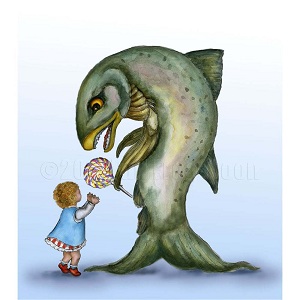
Yes, Virginia, There is a Frankenfish  

A little girl accepts a lollipop from a strange fishlike man

Ginny accepts a lollipop from a Frankenfish

Oblivious to his unusual appearance and his disagreeable body odor, little Ginny eagerly accepted a big lollipop from the eccentric stranger who lives across the street next door to the AquaWhopper genetic engineering labs.

In recent months there, has been much controversy surrounding the FDA’s proposed approval of the sale of genetically engineered fish for general public consumption. The technology is being promoted on the grounds that the modified fish are nutritionally indistinguishable from wild species or conventionally farmed fish. Industry officials further assert that the fish are completely safe to eat and do not pose any threat to the environment, as almost all engineered fish are female and reproductively sterile. Even in the event that a few might escape from the farms, these captive populations are said to be incapable of interbreeding with other fish in the wild and therefore do not pose a threat to the natural biodiversity of indigenous populations. The industry also suggests that an ample supply of high quality farmed fish will reduce pressure on native species caused by overfishing.

Critics disagree with these positions.  For one, escaped fast-growing transgenic fish with voracious appetites might compete for food and habitat with native populations, to the detriment of the latter. Furthermore, environmental concerns aside, detractors are concerned that the FDA’s proposed approval does not presently contain any provision for labeling genetically modified fish as such. Therefore, a consumer would have no way to distinguish genetically modified fish from wild caught fish in the supermarket. The growth hormones used to produce hybridized fish, although ostensibly natural, could have unforeseen consequences with human immune systems that could be triggered by alteration of intestinal flora caused by ingesting bacteria associated with the modified fish. A study conducted in the UK in 2004 explored the possibility of the horizontal transfer of transgenes from modified foods to human intestinal microflora. While the study found evidence of the survival of some genetically modified DNA through the upper GI tract, it failed to demonstrate that the complete transgene had been transferred to host bacteria. Nevertheless, the study recommended that this phenomenon be considered at the time when the safety of genetically modified foods is evaluated for wholesale human consumption.

In a move that would appear to stifle transparency, the FDA is proposing to regulate genetically modified fish as “animal drugs” in order to protect the producers’ proprietary processes and trade secrets. The approval process relies extensively on the producer’s own testing and data, which suggests a conflict of interest whereby data could have been skewed and negative findings suppressed.

Sen. Mark Begich (D-Alaska) recently announced that he was making it a legislative priority for 2011 to defeat the FDA’s proposed approval of genetically modified salmon, or at least to force disclosure on the packaging. This is considered by many to be a fundamental requirement that would protect persons who may allergic to the modified fish. Furthermore, it has been disclosed that modified fish are relatively low in omega-3 content when compared to wild salmon and have also been found to contain considerably larger concentrations of IGF1, which is a hormone associated with various human cancers. Information regarding these risks needs to be made available to the public so that they can make informed purchasing decisions.

Punxsutawney Phil Goes to a Birthday Party

A groundhog is wearing a party hat and holding an acorn

Phil is bringing acorns to the party

After it appeared that PETA’s mechanical groundhog experienced technical difficulties and proved incapable of discriminating between shadows on the ground and damp patches of soil, Punxsutawney Phil was given his weather-predicting job back, at least for this year.

I invited Phil to come over after he finished work to help celebrate my birthday on February 2nd. I will be making margaritas and he’s bringing the healthy snacks.

Punxsutawney Phil Predicts Weather for Seeds and Nuts

A groundhog sits outside his burrows holding a sign

Poor Punxsutawney Phil is out of work

Virtually everyone knows the story of Punxsutawney Phil, the celebrated groundhog who lives on a hill called Gobbler’s Knob in a small town in rural west central Pennsylvania. Every year on Groundhog Day, amidst much merrymaking and circumstance, Phil emerges from his burrows to check his shadow and address the assembled multitude for the purpose of announcing his weather prediction to the formally attired members of his inner circle, all of whom are proficient in Groundhogese and can translate on his behalf.

If on February 2nd Phil fails see his shadow it can mean that spring is not far away. On the other hand, in the event he does see it, the prediction is that six more weeks of winter are in store. For the last three years, Phil has predicted a long cold winter. We hope that this year will be different. That is, if Phil is allowed to perform his duties, as he faithfully has for the last 120 years.

You see, last year PETA successfully argued that Groundhog Day ceremonies were exploitative and that the event should be officiated by a more humane robotic surrogate. Suddenly, and without warning, Punxsutawney Phil found himself out of work and facing foreclosure. Insolvent and with few prospects for gainful employment in a declining economy, Phil has no alternative than to appeal to the charity of his followers and raise money in whatever way he can.

Illustration by Kim Harris
Story by Don Rudisuhle