Art and commentary by Kimberly Harris

Archive for the ‘Animals’ Category

Rescued Penguins Sporting Fashionable New Sweaters

Three penguins are keeping warm with their new sweaters

Three proud penguins show off their colorful new knitted sweaters

On October 5, 2011, the 800-foot long container ship Rena struck the Astrolabe reef off New Zealand’s Port of Tauranga, causing 88 containers to fall into the sea and the release of a fuel oil spill estimated at 360 metric tons. Cleanup crews have recovered much of the oil, but at least a thousand seabirds have been killed.

It is hard to conceive how a tragedy of this magnitude could possibly occur, given that all these reefs are charted and stored in the maps contained in modern GPS systems.

Rescuers are cleaning the birds with canola oil to remove the fuel oil. Then, they are cleansed with detergent. Each bird cleaning requires about 250 gallons of water and takes about a half hour. This process eliminates the natural oils in the birds’ feathers, which makes them vulnerable to hypothermia.

A knitting shop called The Yarn Kitchen put out an appeal for knitters worldwide to make tiny sweaters for the little blue penguins most affected by the spill. Volunteers from far and wide responded to the call and produced a deluge of colorful sweaters, some of them embellished with environmental messages. The sweaters serve a dual purpose – to keep the birds warm until their natural oils are replenished, but more importantly, they prevent the birds from preening themselves and ingesting toxic oil residues.

All was not bad news for the birds. Seagulls were delighted when a broken container full of partially cooked hamburgers washed up on the shores of the Bay of Plenty and disgorged its contents onto the beach.

Illustration by Kim Harris
Story by Don Rudisuhle

Obama’s Magic Loafers and the Solitary Rose

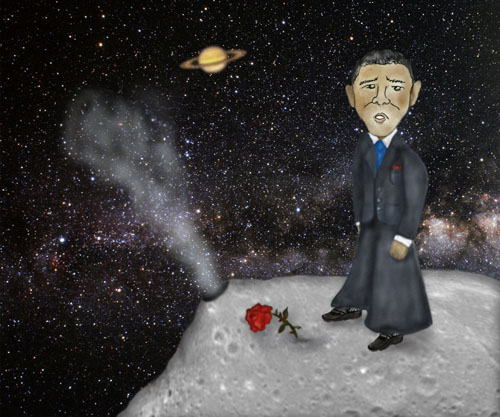
President Obama is on the asteroid Vesta along with a lone rose

President Obama travels to the asteroid Vesta to escape the stress of the debt ceiling debate

On July 6, 2011, President Obama conducted a Twitter Town Hall Meeting where he addressed the future of America’s space program. He spoke enthusiastically about the need to redirect NASA’s vision away from its current model that is rooted in the past and focus instead on aggressive new objectives, like a manned mission to Mars. The president further stated “A good pit stop is an asteroid. I haven’t actually — we haven’t identified the actual asteroid yet, in case people are wondering.”

Late tonight the Dawn spacecraft will rendezvous with the giant asteroid Vesta. Dawn was launched in September 2007 and has now completed the first 117 million mile leg of its historic journey. The probe is scheduled to orbit the protoplanet until July 2012 to take scientific measurements and transmit back images before proceeding on to the asteroid Ceres, where it will arrive in 2015.

As the Dawn spacecraft begins it year-long mission, President Obama is engaging in a difficult mission of his own right here in inner space on Earth. He is tasked with persuading opposing congressional factions to compromise on issues relating to the urgent need to raise the ceiling on the national debt before default occurs on August 2nd. After a particularly acrimonious meeting with House Majority Leader Eric Cantor and House Speaker John Boehner on Wednesday, the President decided to walk out of the negotiations, as it was evident to him that they were going nowhere.

Frustrated and weary by these stressful events, the President concluded that he needed to get away for a spell. Camp David wasn’t really an option, so he decided to perform the ultimate escape to a place where he could experience some peace and quiet and contemplate the state of world affairs in solitude.

With a sharp click of the heels of his magic loafers, a flock of migrating wild geese suddenly appeared and swiftly transported President Obama to Vesta, arriving well ahead of the Dawn probe. To his amazement, the first thing he saw was a lone rose growing in the dry, dusty soil of the arid asteroid.

Recalling a long-forgotten lecture from a world literature class from the distant past, the President realized that he was standing on the very planet that was the home of the Little Prince described by Antoine de Saint-Exupéry nearly 70 years ago. The little man had appeared to Saint-Exupéry in the Sahara Desert where he had performed an emergency landing to repair the engine of the plane he was flying. The President further recalled the conversations the Prince had with the flower and the tenderness with which he cared for it. In particular, he remembered the instance where the Prince was concerned that his beloved flower would be eaten by a sheep during his absence. In comforting the distressed young Prince, Saint-Exupéry promised to draw a muzzle for the sheep so it could not eat the precious flower.

Then, in an inspired flash of genius, President Obama drew two muzzles, one for the House Majority Leader and another for the House Speaker. His problem was finally solved!

Illustration by Kim Harris
Story by Don Rudisuhle

Krampus Takes a Vacation

The horned Krampus monster is on the beach with hula dancers

Krampus relaxes on the beach for a well-deserved vacation

After a long cold holiday season of scaring naughty children into exhibiting better behavior, Krampus takes a well-deserved vacation at a warm tropical location. On the beach on Maui, Krampus sips a cold refreshing beverage while enjoying a presentation by a local hula troupe.

In the United States, Santa is taken for granted. It is a foregone conclusion that Santa will always deliver on the presents. Kids in America don’t know how good they have it because no matter how naughty they have been during the year, Santa will never fail to bring them something. In fact, the very worst they can expect is that Santa will fill their Christmas stockings with lumps of coal. This is not the end of the world, because with the soaring cost of energy reaching unprecedented heights, the children can easily pool their lumps of coal and sell them to the local power utility and use the cash to buy the gifts that Santa did not bring due to their naughtiness.

However, in Europe, children have a lot more to fear, particularly in Austria, Switzerland, Croatia and Germany. In those countries, jolly old St. Nick hands out gifts on his feast day of December 6th. However, he does not punish children himself no matter how bad they have been. Instead, he delegates that task to a terrifying horned creature called the Krampus, who accompanies Santa on his visits and metes out punishment according to Santa’s instructions.

The children that Santa has fingered as naughty are seized by the Krampus, who whips them with a switch of birch branches or with rusty chains. In extreme cases involving exceptionally naughty children, the Krampus is said to carry them in his backpack to the forest where he proceeds to devour them. Alternatively, the Krampus simply stuffs them into a sack which he then tosses into a stream.

People who have observed the widespread lack of discipline, manners and work ethic that characterizes today’s youth have suggested that a serious dose of Krampus might be in order here in America.

The origin of the Krampus can be traced back thousands of years. It is believed that the Krampus was an evolution of the Norse god Loki that was slowly assimilated into Christian tradition. Many European countries today organize Krampus festivals on December 5th, the day before St. Nick arrives. A number of designated individuals dress up as the Krampus and go from house to house scaring children with their growls and their switches and drinking schnapps with their parents. As the night progresses, it is not unusual to see the Krampus throwing up in the gutter.

If a Krampus should approach you in the darkness of night, you will certainly know him by his long horns and his most unusual characteristic of having one humanlike foot and another that resembles a cloven hoof of a goat.

Bigfoot and Chupacabra Celebrate Cinco de Mayo

Bigfoot and a Chupcabra are drinking beer

Bigfoot and Chupi Chupacabra quaff a cold one to celebrate Cinco de Mayo

To celebrate Cinco de Mayo, Bigfoot and Chupi Chupacabra met at a bar at an isolated location in Mexico to share a cold beer and tell spellbinding stories about their adventures frightening tourists, hikers and bird watchers.

Para celebrar el Cinco de Mayo, el Pie Grande y Chupi Chupacabras se reunieron en una cantina en un sitio aislado en México para compartir una cerveza helada y contar cuentos apasionantes de sus aventuras asustando a turistas, excursionistas y observadores de aves.

Chupacabra Cinco de Mayo Fiesta

A chupacabra dances to a chicken mariachi band

The chicken mariachi band is the life of the fiesta

In a small remote village in the north of Mexico, a lovely lady Chupacabra dances to the rhythm of a chicken mariachi band while her husband strums the classical guitar.

En una pequeña población remota en el norte de México, una hermosa Chupacabras baila al compás de un conjunto de pollos mariachis mientras que su marido rasguea la guitarra clásica.

The Birth of Bigfoot

Boticcelli's Bigfoot stands in a clamshell surrounded by extraterrestrials

The Birth of Bigfoot

Art historians in Florence, Italy call an impromptu press conference to announce a shocking discovery regarding an image found to lie underneath a famous Renaissance painting.

Earlier this year, museum curators at the famed Galleria degli Uffizi in Florence, Italy removed 15th century painter Sandro Botticelli’s masterpiece, the “Birth of Venus” from public display so that it could undergo routine cleaning and maintenance. At the museum’s art restoration laboratory, a team of highly experienced conservation and restoration experts employed three-dimensional infrared technology to look beneath the original layer of paint in order to help determine the cause of the 15th century painting’s slow deterioration. What they found shook the foundations of the art history community.

It is not unusual in the case of historical works to find an earlier painting or sketch by the artist underneath a well-known masterpiece, as was the case with Da Vinci’s “Virgin on the Rocks.” However, in most instances, those images were revealed to be sketches that were the basis of the final work, or occasionally, simply a painting that the artist was not satisfied with, leading him to recycle the canvas for a future project.

However, the experts’ scan revealed a shockingly different image that immediately gave rise to centuries-old conspiracy theories and suggestions of a Renaissance era cover-up. For more than five centuries Botticelli’s masterpiece concealed a sinister secret. The image that appeared on the restorers’ computer screens was not a fantasy with Greco-Roman roots, but rather depicted a creature that is all too well-known by present day enthusiasts of cryptozoology and the paranormal: Bigfoot.

Historians speculate that this image may potentially lend credence to the long-held theory that Bigfoot, the Yeti, the Chupacabra and other creatures of legend and folklore may in fact have otherworldly origins. Most students of art history are aware of the abundance of images painted over the centuries that would appear to depict UFOs and their extraterrestrial occupants.

Fellow Florentine painter and Botticelli contemporary, Domenico Ghirlandaio painted his “The Madonna with Saint Giovannino” which clearly shows a mysterious glowing object suspended in the sky above Mary’s shoulder. Also from the same period, “The Annunciation” by Carlo Crivelli, shows an airborne disk directing a focused beam of light right through a building onto Mary’s head. Could visitors from another world have brought strange creatures to live among us, and to what end?

Scholars agree that Lorenzo de’ Medici ordered Botticelli to paint the canvas over because he feared that Savonarola, the Dominican monk who was at the time campaigning vigorously for the destruction of immoral art might denounce it as an act of heresy and order its authors to be punished.

Illustration by Kim Harris

Implausible yarn by Don Rudisuhle

Kim Qui, The Golden Turtle God and Guardian of the Sword

Kim Qui, the sacred turtle sits on a rock with a sword

The Golden Turtle God and Guardian of the Sword

In the news today is a troubling story concerning the sacred turtle of Vietnam’s Hoan Kien Lake. This rare and endangered turtle is sick and slowly dying from pollution.

The following story from our Squidoo Lens, The Mysterious Creatures of Cryptozoology is about the legend of Kim Qui and some information on the turtle itself.

Kim Qui is a legendary turtle that has repeatedly come to the assistance of Vietnamese rulers over the millennia to help them defeat their enemies and defend their kingdoms from invaders. In a story parallel to that of King Arthur and Excalibur, there is a traditional account about how Kim Qui, the Golden Turtle God, gave Emperor Le Loi a magical sword bearing the inscription “The Will of Heaven.” This sword gave the emperor great strength and was instrumental in his leading his forces to defeat the invading Ming Chinese armies in 1427. Following his victory, Le Loi was boating on Luc Thuy (“Green Water”) Lake when the turtle deity Kim Qui suddenly rose to the surface and seized the sword in his mouth and promptly vanished back into the murky depths. The emperor bemoaned the loss of this precious sword, but was eventually persuaded that now that his kingdom was again free, the sword’s rightful owners had reclaimed it. The emperor then proclaimed that Luc Thuy Lake be renamed Ho Hoan Kiem Lake, which means “Lake of the Returned Sword.”

Hoan Kiem Lake is located just west of the Song Hong River (“Red River”) in an urban setting near Hanoi’s Old Quarter and about a mile southeast of Truc Bach Lake, where John McCain landed after being shot down by a North Vietnamese anti-aircraft missile in 1967. In the middle of Hoan Kiem Lake, there is a small island with a structure known as The Tortoise Tower that commemorates the Kim Qui legend.

In scientific terms, Kim Qui is a Yangtze giant soft-shell turtle, which is formally known as Rafetus swinhoei. Weighing in at around 400 pounds, it may be the largest fresh water turtle in the world. It is easily identified by its pig-like snout and nostrils.

Aside from the single specimen known to live in Hoan Kiem Lake in Hanoi and presumed by many to be the legendary Kim Qui, there only four other known surviving members of the species. These are located at zoos in China, and several are estimated to be between 80 and 100 years old. Other individuals have recently been observed in the wild, but the species has been seriously depleted by pollution, human encroachment into its habitat, especially the damming of rivers and the mining of sand, and also from hunting for food or the supposed medical properties of its shell and bones. This has prompted the International Union for Conservation of Nature and Natural Resources in Switzerland to list Rafetus swinhoei as “critically endangered.”

President Obama Appoints a Cheese Czar

President Obama Appoints a Czar to manage the Federal Cheese Reserves

Dr. Al Gorgonzola, the newly appointed Cheese Czar

After reading alarming accounts in the news regarding the possibility of widespread food shortages in the near future, President Obama met with key officials in his cabinet to be briefed about possible measures he might propose in order to mitigate the impact on the citizenry.

The President had just seen the World Bank’s recently released Food Price Watch report which announced the disturbing news that the Bank’s Food Price Index had gone up by 15% in the three months between October 2010 and January 2011 and is a full 29% above its level a year ago. The U.N. Food and Agriculture Organization further stated that a 30% increase in food prices would be likely next year as well. The President’s advisors explained that a number of factors were at work, and that these were largely beyond anyone’s control, with global warming as the primary culprit. Among causes cited were devastating floods in Brazil, Pakistan and Australia, unprecedented droughts in Russia, Argentina and China and below average harvests in the United States and other countries. Increased demand and domestic inflation resulted in higher rice prices in some Asian and African countries and the diversion of corn for the production of ethanol was also considered to be a cause for increased prices in basic foodstuffs, including beef and poultry. In the United States, it is predicted that this year 40% of domestic corn production will be destined for processing into biofuels.

The officials were at a loss as to how to shield the US against this dangerous global phenomenon until Agriculture Secretary Thomas Vilsack reminded the President of the existence of the nation’s Strategic Cheese Reserves, which are stockpiled deep underground in caves in Missouri. This hoard is the result of a longstanding federal program dating back to the Depression Era whereby the government purchased much of the excess cheese that was produced by the dairy industry. Only officials with high security clearances know for sure, but there is said to be well in excess of a million tons stored there with a current market value approaching $9 billion. Secretary Vilsack proposed that this cheese be mobilized and made available to needy people, much in the fashion as food stamps are today.

The President’s new Press Secretary, Jay Carney, even went as far as to suggest that Mr. Obama could garner favor among low-income voters by pitching bricks of cheddar from a White House balcony into a crowd of hungry, chronically unemployed, although the group unanimously discounted this idea.

The first lady was horrified at releasing the estimated 23 trillion calories stored in the cheese caves to an already overweight public, fearing that this would undermine her “Let’s Move” anti-obesity campaign. However, Mrs. Obama agreed to listen to all of the arguments put forth at the meeting.

Interior Secretary Ken Salazar cautioned the President that for some time, the United States Geological Survey had been concerned that increasing underground geothermal activity caused by climate change could heat the cheese to the point where it would melt and violently erupt out through fissures in the rock, and potentially smother entire communities with a scalding yellow ooze. Secretary Salazar suggested that this would be an opportune time to release the stockpiles and clear out the caves, because FEMA would likely be incapable of dealing with a catastrophe of this nature, as their rescue launches would not be able to navigate in a medium as dense as molten cheese, which would quickly clog the heat exchangers on their engines.

Prior efforts to mitigate threats to the public and avoid a catastrophic caseous meltdown, numerous federal initiatives have been in place for some years. In 1995, the Department of Agriculture created a non-profit organization called Dairy Management, Inc. It is funded through assessments charged to the dairy producers and the taxpayer dollars and has a mandate to increase demand for U.S. dairy products.

Unfortunately, attempts to reduce the vast stores of cheese have only been met with moderate success. According to the New York Times, the best promotional efforts put forth by Dairy Management Inc. and the Department of Agriculture in their 2002 partnership with Pizza Hut in their celebrated 2002 “Summer of Cheese” only resulted in a meager incremental consumption of 102 million pounds cheese, which scarcely put a dent in the 1.3 million tons that are believed to exist in the nation’s underground repository.

Recognizing a unique opportunity to solve two worrisome problems at the same time, President Obama and his advisors moved swiftly to put a plan into action. Due to the magnitude and complexity of the undertaking, the President soon realized that it would be necessary to appoint a Cheese Czar to oversee the operation. After consulting his most trusted advisers, Mr. Obama soon settled on his leading candidate, a distinguished industry expert named Al Gorgonzola. Dr. Aloysius Gorgonzola earned his PhD in Food Science from the University of Wisconsin and later spent some time as an Assistant Professor at the Wisconsin Center for Dairy Research. As an articulate speaker and an authority on cheese production and long-term storage, Dr. Gorgonzola fit the bill perfectly for steering America’s cheese policy and running what would soon become a high-profile operation with considerable public and media visibility. Within days of his nomination, the White House held a formal ceremony in the Rose Garden and invited many of Washington’s luminaries to participate in Mr. Obama’s historic conveyance of the prestigious title of Cheese Czar to a beaming Dr. Gorgonzola.

When Fox News television host Greta Van Susteren read the White House release, she immediately recognized Dr. Gorgonzola as a fellow Wisconsin cheesehead, and quickly contacted his office to arrange for him to appear on her show, “On the Record” and defend his suggestion that the state’s iconic football team be renamed “The Green Cheese Packers” because they always shoot for the moon.

Illustration by Kim Harris
Story by Don Rudisuhle

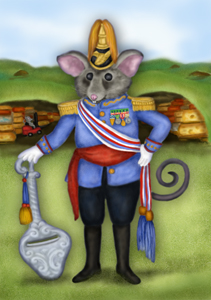
Jonathan Roosevelt Rat Portrait

Jonathan Roosevelt was a piebald rat that was one of President Theodore Roosevelt’s many exotic pets. He lived in the White House in the early 1900s and liked to play with the president’s children.

A portrait of President Theodore Roosevelt's pet rat

Jonathan Roosevelt Rat's Presidential Portrait

There has been a longstanding rumor that Jonathan rode in Teddy Roosevelt’s front jacket pocket during his famous charge up San Juan Hill during the Spanish American War. The actual truth was that he stayed home and took advantage of Colonel Roosevelt’s absence to conduct a raid of his own on his master’s cheese cellar back at Oyster Bay, New York

Piebald is a generic expression used to describe an animal that has patches of black and white or other colors.

Dusty the Hopeless Romantic

Dusty the bulldog leaves Fifi the poodle yellow love notes in a snow drift.

Dusty, the Hopeless Romantic

Dusty was a hopeless romantic who often left love notes in the snow for the objects of his affections.